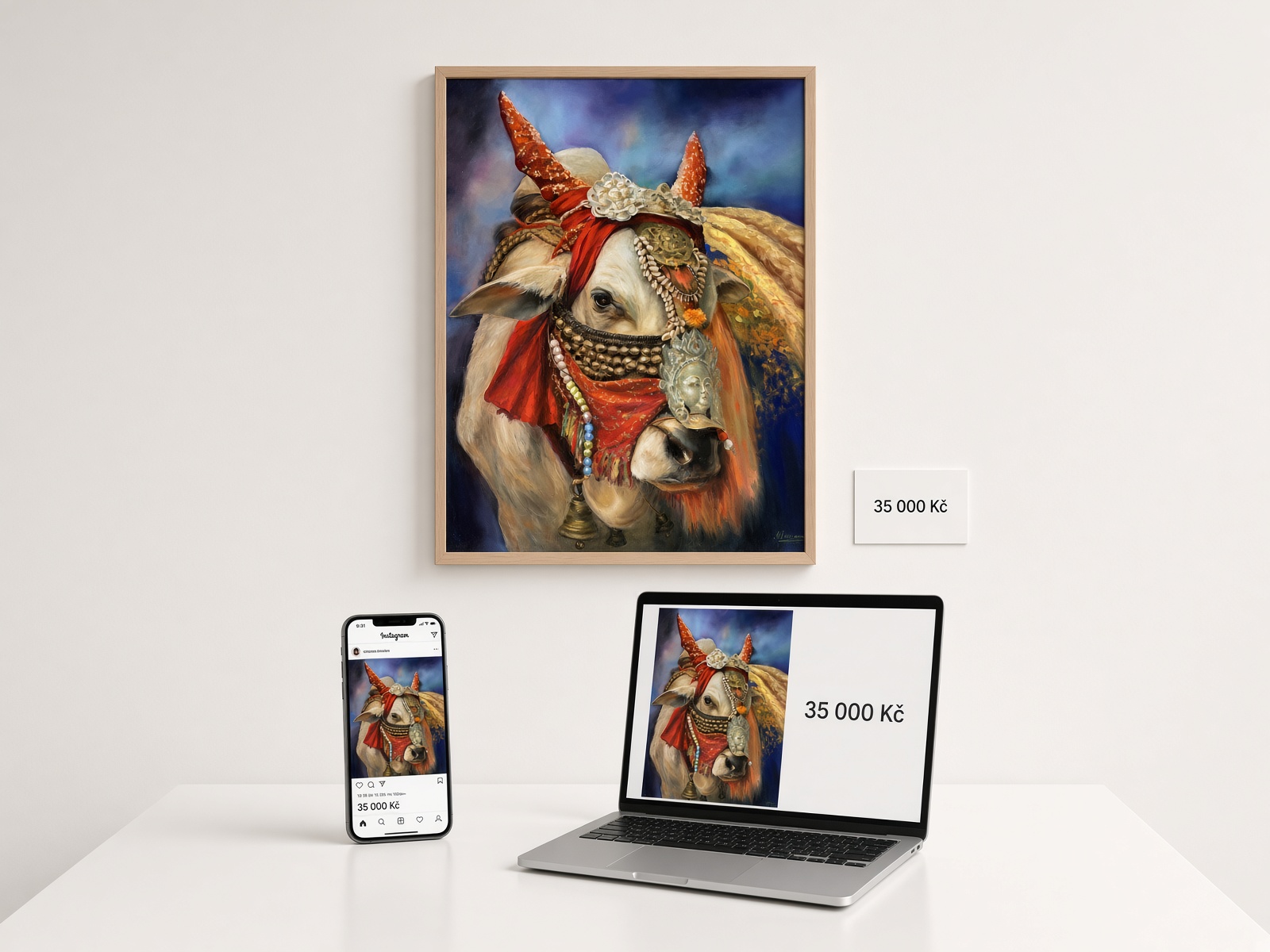
An artist can showcase the same work simultaneously on a website, on Instagram, in an online gallery, at a group exhibition, and in a physical gallery. That’s fine. The problem doesn’t arise from the fact that the work is visible in multiple places. It arises when the work has a different price at each location and no one knows which one is valid.
The client will compare prices. So will the gallery. And if you don't answer first, they'll answer for themselves. Usually the wrong way.
The price of the artwork is not the price per wall.
Exhibition fees and the price of a painting are two different things. If you pay 10,000 Kč to participate in an exhibition, that’s no reason to automatically raise the price of the work by 10,000 Kč. The exhibition fee is your cost of presentation. The price of the work is the amount the client should see.
The same goes for commissions. The gallery takes a cut of the sale for its work: communication, viewings, administrative tasks, packaging, and delivery. That’s not a reason to have one price at the gallery and another on Instagram. It’s a reason to know how much you’ll have left after the sale.
First, determine the price of the artwork. Only then should you calculate how much it costs to have it displayed.
The client doesn't see your costs. They see two numbers.
Example: You have a piece in a gallery priced at 35,000 CZK. At an exhibition where you paid a booth fee, you’ll offer it for 75,000 Kč. The client sees both prices. They don’t know you paid for the wall space. They don’t know what the commission is. They don’t know if it’s part of a new series. They see the same painting, but for twice the price.
The question they ask themselves is simple: Why is this more expensive here? The second question is usually trickier: Which number is the right one?
Trust in art crumbles just as quickly as it does in the auto industry. The varying prices for the same piece are the first thing to erode that trust.
You may change the price. Not based on the address.
The price may go up as your work expands: a new series, a different format, more expensive materials, or a different phase. The client will understand this if you can explain it clearly.
What they don’t understand: that a work costs 35,000 Kč online and 75,000 Kč because it’s on display in a different building. A different gallery doesn’t automatically mean a different price. Nor do different presentation costs.
If you change the price, change it everywhere. And know why.
Ask where the client came from.
This is a practical rule that helps preserve relationships for everyone involved.
When a prospective buyer contacts you, feel free to ask them directly:
- Where did you discover the artwork?
- Through which gallery, exhibition, or profile?
This isn’t an interrogation. It’s about being fair to the place that brought you the client. If they found the artwork at Gallery A, the sale belongs to Gallery A—even if they message you on Instagram. If they found it on your website and just want to come take a look, let the gallery know. No one should have to guess.
It's just as fair to tell the gallery in advance:
- How much are you offering the work for elsewhere?
- that you changed the price
- that the work is no longer in the public domain
The gallery cannot justify a price that isn't listed on your website.
Before you offer your work to another place, consider these five things
- What is the current price of this particular piece?
- How much does this spot cost me—the rental fee, the commission, or both?
- Is it the same on the website, on social media, in the gallery, and at the exhibition?
- When I change the price, do I have a reason that the client will accept?
- How much will I actually have left after the sale?
Once you know this, you don't set the price based on your mood. You set it based on the brand.
Why Are We Talking About This?
At Original Gallery, we don’t want to tell you how much your artwork should cost. You set the price. We want you to charge the same price everywhere and to know who referred the client to you.
One piece. One price. And one question: Where did you find us? This isn’t an inspection. It’s a matter of courtesy—toward yourself, toward the client, and toward the gallery that’s helping you close the deal.
The Original Gallery Team